AgentHound not seen online
Offensive collector that inventories and tests AI agent infrastructure from a compromised host: agent clients, MCP servers, model gateways, vector stores.
This agent is not tracked. It is a single binary dropped on a host; its optional analysis server listens on port 8080. The tracker therefore lists no host for it; this page describes it from its published source.
About AgentHound
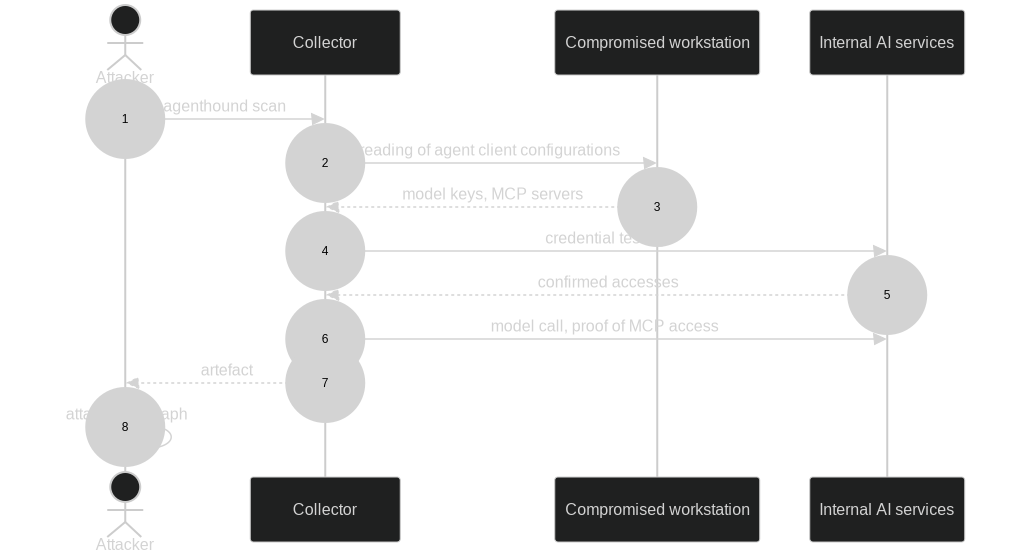
It is not an AI agent: it attacks other people's. It is active by default (credential validation, model calls, reversible change of an MCP tool description); --stealth makes it read-only.
- Language
- Go
- License
- Apache-2.0
- First release
- 2026-04
- Capabilities
- post-exploitationcredential attacks
How to spot it in your own logs
Read from the published source, not observed in an attack. Whoever runs the tool can change them, so a missing trace proves nothing.
Behaviour
one host querying LiteLLM, Ollama, Qdrant, MLflow, Jupyter and Open WebUI in a row
On a machine that runs it
binary agenthound, commands agenthound scan / --stealth / --deepserial reads of agent client configuration files (.cursor/mcp.json, Claude Desktop config, CLAUDE.md, AGENTS.md)
How it works
Drawn from a review of the published source code; no tool was run. A diagram shows what the code can do, not what a given operator did. Click a diagram to open it full size.