WebKiller not seen online
Desktop application that maps a web target, then lets an AI agent confirm vulnerabilities with a capped number of requests.
About WebKiller
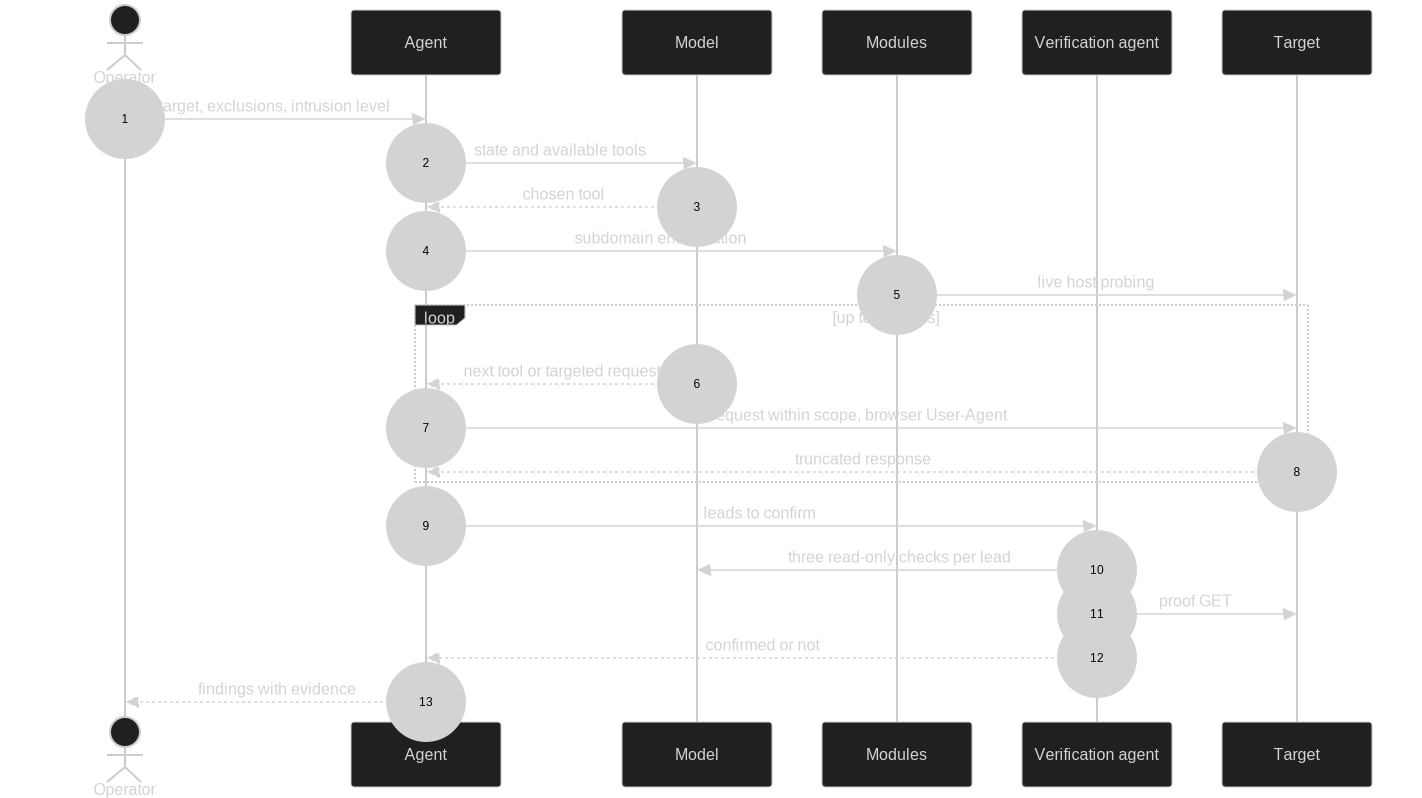
WebKiller 3.0 is an Electron application with some forty modules: subdomains, live hosts, ports, API routes, cloud storage, then confirmation of common web flaws. In agent mode a model picks among a closed set of tools; the code, not the model, checks the scope of every request, and hard limits cap the tool calls, the HTTP requests and the tokens.
By design it never names itself to a target: its requests carry a common browser User-Agent. Its own name only appears as a fallback when that setting is empty.
- Language
- JavaScript
- License
- PolyForm Noncommercial 1.0.0
- First release
- 2026-11
- Capabilities
- reconnaissanceweb testing
How to spot it in your own logs
Read from the published source, not observed in an attack. Whoever runs the tool can change them, so a missing trace proves nothing.
User-Agent
a common browser User-Agent by default (Chrome 131 on Windows, or one of seven picked at random)WebKiller/3.0 (fallback only, when the User-Agent setting is empty)
Headers
X-Original-URL, X-Rewrite-URL, X-Custom-IP-Authorization, X-Forwarded-For: 127.0.0.1 sent in a row on one refused resource
Outbound traffic of a machine that runs it
User-Agent WebKiller-Installer/3.0 towards the download sites of nmap, nuclei, ffuf, httpx, subfinder
How it works
Drawn from a review of the published source code; no tool was run. A diagram shows what the code can do, not what a given operator did. Click a diagram to open it full size.